INTRODUTION (00:00):
Across the country, the future of local economy is being shaped by forces we can't ignore. An aging workforce, slowing population growth and rapid changes in the skills employers need to stay competitive, in the age of big data and AI. All of which give life to some important questions: How will the workforce evolve? What do the most competitive jobs of the future even look like? And how are communities staying ahead of preparing the next generation to step into local demands?
Cecil Criswell (00:32):
Cecil: You want to be innovative. We understand life happens in school and you have to manage that. At the same time, you've got to also be looking forward and figuring out how do I get my kids ready for those jobs that don't exist?
INTRODUCTION CONT. (00:46):
Because preparing young people for the jobs of the future isn't just the responsibility of education alone, it's a partnership between community, industry, and education. And it’s how entire regions stay competitive, resilient and economically strong for tomorrow.
Susan Wally (01:01):
There is so much talent in these schools, especially our high schools, that just doesn't get the opportunity to be developed. And so, what can we do to really, in a systemic way, just develop more talent so young people have more opportunity and then so the workforce, the employer is looking for talent, so we enrich the workforce in that process.
INTRODUCTION CONT. (01:15)
Today we're tuning in from Kansas City, a community known for its world class barbecue, beautiful public fountains and jazzy cool music heritage. Located in both Kansas and Missouri, the community also touts a diverse population with a rich industry presence and an out loud commitment to innovation, growth, and sustainability. In an era of competitiveness where economic growth depends on cultivating skilled talent, helping local young people connect to real world learning opportunities helps entire communities, like Kansas City, continue to thrive.
My name is Mariah Presley, the Education and Industry Programs Leader at Trane, and you're listening to this Educational Life, a Trane podcast where we share real stories of heroes in education who are leading big innovation through small acts of alignment.
Today, we're talking with some of the leaders behind an organization committed to redefining industry education collaboration that leads to community success, starting with a relentless focus on urban schools right here in Kansas City. Let's get to it.
Mariah Presley (02:34)
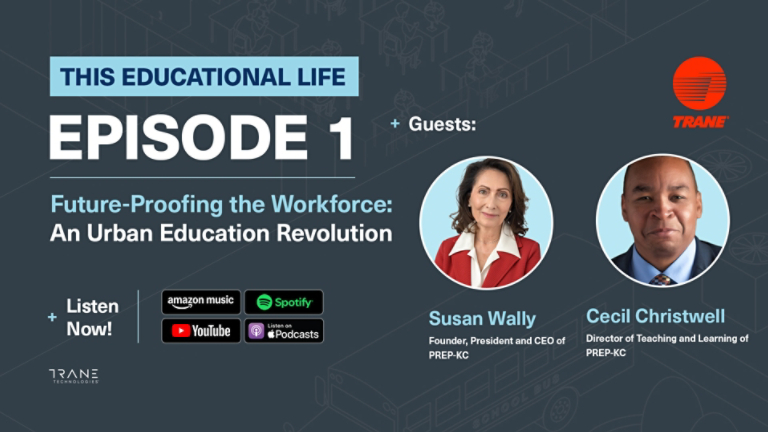
Hello and welcome back to Season 2 of this Educational Life podcast. And I am so excited to be joined today by two of our leaders right here in the Kansas City area, Susan Wally and Cecil Criswell from PREP-KC. Susan, Cecil, you want to introduce yourselves?
Susan Wally (02:51)
Thank you, Mariah. Thanks so much for giving us the opportunity to be here. We're especially excited to be here with our Trane partners because we've been working together and connected for a number of years. And in some ways the work we're going to talk about is culminating because of some of the early influences Trane had as we looked at how we put really innovative partnerships together between business and industry and K12 public education. So, I'm Susan Walley. I'm the CEO of PREP-KC and also the founder of PREP-KC. In April of 26 will have its 20th anniversary and we've been working for these years evolving our strategies, but working with six urban school districts in the heart of Kansas City, both sides of the state line, because, you know, Kansas City is a bi-state city and working very intentionally to provide a lot more business and industry experiences and awareness and opportunity that can be integrated into the school day. As it comes to giving kids the opportunity to have an aspiration to understand what they're good at, what kind of jobs they'd like to have, what kind of education it's going to take. So, we're just excited to have this conversation with one of our most innovative business partners.
Cecil Criswell (04:09)
Yeah, Cecil Criswell, Director of Teaching and Learning with PREP-KC. Been with PREP-KC for six years, previously 16 years as an educator and administrator in the Kansas City, KS Public School District. I'm excited about what we're doing with PREP-KC, primarily because PREP-KC's mission around igniting potential and ensuring that zip codes won't matter in regards to students education and providing them opportunities so that they can be competitive on a global perspective. So, excited about the work we're doing and the opportunity to get kids connected to what's relevant currently in the workforce and giving them a chance. So I'm happy to be here.
Mariah Presley (04:50)
And we're so happy to have you as well. One of the things I shared before that I love so much about PREP-KC is this relentless dedication to the greater Kansas City urban area. Looking back 20 years ago for why this kind of work, this focus on workforce development with this area? Why was this so important to Kansas City here? Why was this the mission you took on?
Susan Wally (05:13)
Kansas City struggled to help its urban school districts get better. And for decades, business and industry tried to make, you know, investments to provide technical assistance, to try to figure out how to make the Kansas City, Kansas and Kansas City, MO, the two districts that have Kansas City's name on it, how to make them better and more vibrant and producing, you know, more opportunities for the young people in the communities, especially these young people that depend heavily on their public education for their future.
Just about 19, almost 20 years ago, for a lot of reasons, I had the opportunity to think maybe there needs to be an organization, an intermediary that brought a number of these districts together, gave our corporate, private and family foundations the opportunity to co-invest around some very strategic work over time to improve the opportunities that public education could provide to the students who are depending on their urban schools. So that's really our motivator.
The other part of it for me is a belief as a former high school teacher and principal, and I had time in educational philanthropy, just the belief that there is so much talent in these schools, in these, especially our high schools, that just doesn't get the opportunity to be developed. And so, what can we do to really, in a really systemic way, just develop more talent so young people have more opportunity, so the workforce, the employer's looking for talent. So, we enrich the workforce in that process.
Cecil Criswell (06:54)
Running parallel to what Susan talked about there with, you know, the need to prepare students and connecting, students with industry. PREP-KC has also had a connection with supporting schools, ensuring that students are getting a chance to excel with respect to math and literacy. So, my early connection with PREP-KC, I was a former high school math teacher, always a math teacher, but former high school math teacher in KCK. And at the time we were really focused on trying to improve the students’ math experience. And knowing that if we did that, it would increase their chances of earning market value assets and opportunities for internships and other experiences. So, I think that's another piece that PREP-KC saw that, you know, in addition to industry opportunities, ensuring that if kids are getting the right academic experiences at the right time. So thinking K12, then students can be ready when they get that high school diploma. So yeah, I'm excited about what we do.
Mariah Presley (08:02)
I really see PREP-KC is this bridge between industry, between education and bringing those two worlds together so that we can get students a little bit more equipped and prepared when they come to Trane or any other workforce in the greater KC area and beyond to be more successful. And all of that work I know has not happened overnight. Can you share a little bit about some of those maybe daily acts of resourcefulness or the partnerships or the steps that it has taken for you guys to sort of innovate this world forward and bring that experience into the classroom?
Susan Wally (08:38)
When we were starting nearly 20 years ago, if you remember what the landscape was like in public education there was a lot of talk across the whole country about the loss of students in urban high schools, the dropout rate essentially in urban high schools. The National Governors Association was holding forums on that, and all kinds of national foundations were trying to figure out how to invest to help that problem.
And that was when PREP-KC came on the scene, because as we started in those first few years to help our high school partners in our urban school districts start to connect business and industry and higher ed too, with the experiences starting in high school, we heard stories about how kids that were not even passing were starting to sit up straight and lean in and ask questions and start to see their future differently because there were these real live women and men from business and industry talking to them about what their future could be and the kind of jobs they could have, the opportunities in their future if they did certain things, made good decisions while they were still in their K12 education, especially while they were in high school. And we started to think, what would it look like if all the kids got an immersion in these interfaces with business and industry folks that really helped guide their thinking about what their future could be and how they could be contributors to their community.
Cecil Criswell (10:05)
I think at the core of that, adding on with Susan saying there, as an innovator, we're helping schools think about school differently. All of us have our picture of how school we grew up and how school was, and the reality is that it really hasn't evolved to where society is. Schools have a lot to manage, you know, with what's going on in school. They also want opportunity to be innovative, but from a capacity standpoint, they might not be able to live in that space as much as they want to. So being able to have a thought partner to think about school differently. Think about experiences. Think about what could we do different for all of our students to access, these various opportunities.
Susan Wally (10:51)
Two places where PREP-KC’s had the opportunity in our partnership with our school districts and our business and industry leaders to innovate. And the first was several years ago, when we started thinking out loud and with lots of other folks thinking about this, is a high school diploma adequate to set a young person up for a good future? And the more we thought about it, the more the whole, you know, country thought about it. We started realizing high school diploma was not adequate and we did actually did a five-year pilot, but we started to think what could we help our high schools? We happen to work at PREP-KC with 20 urban high schools. What could we help them build into just every school day, every school week, every semester that would change the trajectory of young people after high school? Especially kids from lower income communities, our students of color, first generation college goers, the whole array of kids that we serve. And the result of that five-year study was there were assets, things like great internships and industry credentials that our regional employers value and dual credit and entrepreneurial projects. And so, we started the process of helping build those into the school days, starting with our high schools and then moving upstream overtime with middle and elementary. But that whole concept of graduating with a diploma plus some of these market assets really became an innovation. (12:18)
CHAPTER 1: SMALL ACTION INNOVATION (12:19)
PREP-KC's innovation model isn't built on sweeping reform. It's built on practical, repeatable action. By embedding industry engagement into the rhythm of the school day, PREP-KC helps schools do what they want to do, but often lack the capacity to sustain alone. This is how systemic change takes root. One classroom, one partnership, and one experience at a time. And the idea of graduating diploma plus by earning a market value asset is taking off not just here in Kansas City, but across the country, where even industry are starting to see how valuable it is to offer young people real world learning experiences.
Susan Wally (12:59)
We worked with that idea for a while, but then our region started to pick it up and other foundations invested in it, business and industry invested in it. And that innovation actually led us to the opportunity to then be the platform for our new data science work that Cecil is leading.
Mariah Presley (13:19)
And I know a really cool option that you guys have really built here in the Kansas City area is this programming around data science. So out of the gate, how did you determine this level of focus around data science and what really got you started down that path?
Susan Wally (13:37)
We were saying to ourselves, as we think about doing systemic change and scaling systemic change, are there some issues and some topics we should be thinking about that really cut through all of those careers? And so, I had the opportunity to just interview informally, not very scientifically, but lots of C-suite leaders, talent, pipeline folks, HR folks and asking a question: What should a young person at the high school level today definitely be good at for almost any job? And it was really interesting to hear these employers talk about basically you boil it down and it had to do facility with data. It almost surprised me. I expected maybe different answers, but they talked about how the whole world is now just awash with data and if you know how to use it and have tools for using it and using it well and using it ethically, you really have some skills that are important to almost any employer.
That really got us thinking. I really reflected on the power of engaging with data and data analytics, was looking at some of those programs that Trane has provided into public education. The projects you offer like kids to look at the HVAC systems in their schools and to look at energy consumption in their schools and to ask questions like why is it so high at this time and so low at this time? And that really stayed with me as we started to think and to watch the kids get so excited about something that was really about their own school and their own school day and school week. And it really, I think, pushed all of our thinking toward this idea of getting good at data analytics.
CHAPTER 2: DATA ANALYTICS (15:20)
Trane, like many other technology companies, is constantly reinventing how we equip, recruit and retain talent. And in the fast changing, highly competitive environment we're in, the question of how we get in front of talent earlier becomes all the more important. So those programs that Susan mentioned Trane has? Well, they're built around a mission to equip learners earlier with high value, transferable skills that make them more competitive. And what's at the forefront of that skilling focus? You guessed it, data analytics.
Cecil Criswell (15:56)
And I think adding to that - Susan talked about those companies - they talk about how they use data. I think that's a byproduct of I think we're out of it or in this new age, but we were in this information age. So, information was being accumulated, but now people are realizing or companies are realizing, I've got information I can turn into data and use it to improve my bottom line or use it to help improve, the lives of my customers. All of us are consumed with data, you know, daily. Every student almost has a smartphone, they're adding to the dataverse, every day. So how do we help students see that and then also see, hey, you can build skills as a problem solver with data to help any industry, any industry you want to, you want to be part of.
I think the other piece of that that we saw, as Susan and others were having conversations with our industry professionals about this, they're moving very fast and our school districts are moving not as fast. So, there's this gap of how are we getting students ready for these jobs that don't exist or newly exist.
Susan Wally (17:12)
On that theme, one of the early conversations we had with our school districts when we were asking their leaders to consider working with us to implement this course. We had data from some national sources that said that skills in data analytics actually in some cases boosted Algebra 2 scores on the state assessment. Because algebra and analytics they have some common characteristics and so, of course, every district is looking to do as well as possible on the state assessments. We also had good data from national sources that said there was a significant percentages of questions on the ACT and the SAT that involved analytical thinking. So, analytics skills could boost, you know, college access scores as well.
Mariah Presley (18:05)
What are some opportunities you see for our leaders in public education to really get their students involved, really get them moving down this pathway of learning a skill that can give them a competitive edge like data science and really any career field?
Susan Wally (18:22)
It's a place where it isn't just about learning technical skills so that you maybe go into a skilled trades and you've got technical skills or maybe you're going to become a lawyer. There are a lot of technical skills around being a lawyer. The idea of cultivating curiosity. You know, data science cultivates curiosity and it also cultivates creativity because you know young people start to ask if this is the case in this piece of data, what would it be like if you tried this way of looking at it? And in fact, one of my stories that I've mentioned before is one young man in our 8th grade data in action course, our semester course that we're implementing, one of his big AH-HAH’s was he told his teacher, “I discovered that I'm a creative person!”. And I thought that is really an exciting discovery to have the confidence in yourself that you are creating, that you can come up with new ideas. And where does that going to take that young man if we can help him maintain that curiosity and give him tools to answer the questions he's curious about, and I think a lot of data analytics tools are part of that answer.
Chapter 3: CURIOSITY AS A SKILL (19:30)
This movement highlights something profound. Competence grows when students are empowered to ask questions and encouraged to explore. PREP-KC’s work cultivates curiosity, critical thinking and creativity. Skills that employers increasingly cite as essential in a rapidly changing workforce.
Cecil Criswell (19:50)
Yeah, just to add on, can students ask questions? Can students seek evidence to get answers to those questions? Can they analyze, can they model that evidence and can they communicate the results? That's really the data science process and that's the core of the course that we designed.
And when I explained that data science process, recently here as February of 2024 study talked about one in four jobs has some of those skills that are listed that are required. Being able to think like a data scientist, you don't have to be a data scientist to do that. And that's huge because as technology is moving fast, your ability to skill employees or hire employees that have those official credentials, it's just moving too fast. So, they need people immediately that can step in, learn along the way, but have enough confidence where they can, you know, use the problem-solving skills they have to do the jobs.
Mariah Presley (20:53)
And data is everywhere, right? So, we have the opportunity when we talk about building things into an experience, just to get started thinking about where does data exist in my school district, in my community? How can I really throw out, you know, a question for a student and be an advocate for them and helping them understand this process of really what is, as we describe it at Trane, modern day critical thinking. Utilizing that evidence in those many, many points of data at your disposal to make better, more effective decisions and even decide which decision to make. So, I really appreciate the work you've done to do that.
Susan Wally (21:34)
You know, Mariah, you're reminding me of a story Cecil told us in one of the early implementations of our data in action course for 8th graders. And he said he had the opportunity to talk to the mother of a young man who was in the course. And she said, “Oh my gosh, he comes home and says to me, Mom, that's a data set. That's a data set. This is a data set.” His mind had been really expanded to see data is everywhere, data sets are there and now what do you do with them? How can you tell a story with that data?
One thing that comes to mind for me is the fact that both in our 8th graders opportunities to pick data based problems and work with the data and come up with ideas for getting better or for solving things - it's very similar to our client connected projects, which means that business and industry kind of pitch an idea that they're working on that they haven't solved yet and let kids do some, you know, analysis and research and come up with a potential solution.
It's similar to what we're calling community impact projects, where we let kids figure out a problem in their community and gather data on it and then pitch a solution. And it's been really interesting to see kids figure out disparities by zip code in your access to health care. Or to look at, you know, gender differences in certain career areas and why those exist. A couple years ago, looking at the opioid crisis and coming up with solutions that they could see might work in their own communities because they've seen the impact in their own communities. (23:06)
I think the opportunity to not just get good at data, but to solve real problems with data is what is igniting some of this interest back to being a good problem solver, back to being creative, back to being innovative, and the kind of almost like the dopamine rush that you get when you figure out that you can have those kinds of impacts on the world around you.
Cecil Criswell (23:38)
I think another connection that we've discovered in our few years of implementation here, another student their, I think their mom works in like the finance industry or something, but she had mentioned that she had to take like either the same or similar certification for her current job. So really have the full circle moment for that student because here's something they're learning in the eighth grade and they're receiving that certification, very similar to what their parent just had to do to upskill their learning.
So, students were able to see that relevance, all of us being educators here, you know the classic question, when am I ever going to use this? I believe this class we've developed, we've been able to bring that to students pretty quickly or pun intended, we're able to show data in action.
CHAPTER 4: DATA IN ACTION CLASS (24:25)
What Cecil just mentioned is PREP-KC's data in action class. And it's just one piece of a larger commitment to empower Kansas City students with hands on data science education. Through competitions, courses, and access to real industry partnerships, students get to practice honing a skill that is in high demand across multiple workforces. And the business and industry network in Kansas City seems to agree.
Susan Wally (24:52)
Another facet of that is that how many employers, talent, pipeline managers and companies have said, I wish my kids had had this opportunity, especially if their kids are out of school or in college now. They're just saying, wow, this, you know, I wish I'd had this opportunity. I wish my kids had had this opportunity because I would have started earlier thinking the way I need to think to advance my career and advance my opportunities.
Mariah Presley (25:21)
Yeah, and I know that it takes a village. So having resources like your roles at PREP-KC, having industry partners, having, you know, someone like you were saying earlier, Cecil, just to be a thought partner can really make all the difference. What are some of the things that you've seen or maybe some of the approaches you have taken at PREP-KC to really support building capacity? And making some of these programs and this impact that we're having on students here something that can last?
Cecil Criswell (25:52)
You know, our PREP-KC team has a good knack for helping districts understand their history and a lot of different leadership seats, from Superintendent even down to the principal, teacher level, when life happens and personnel changes, PREP-KC has been a constant. I think also too, our team does a good job of when we say build capacity, helping over time, helping the districts assume that ownership. It's not something that, you know, PREP-KC designed and you're going to do this, and you know it's a collaborative innovation. So, there's ownership from the beginning and that's something we have to cultivate and kind of like we talked about, we know the school personnel has multiple things that they're focused on, but you know that innovation piece and ownership piece, we have to keep growing it.
Each district, it looks different because personnel and you know we're all human and human beings have different needs. So, the constant touch points allows us to continue that innovation, build capacity. If it wasn't for the relationships that you know, Susan developed over the years, a lot of work, we wouldn't be able to do. So, like I said, Susan, really appreciate the foundation you've set for us to be able to do that because relationships matter.
Susan Wally (27:16)
Well, you remind me that so many of the business and industry partners in all different career areas around the Kansas City economic ecosystem, so many of them have said to us, we really want to help. We just never had an easy way to do it. Easy meaning we still have full-time jobs. We still have businesses to run. We still have shareholders to report to. But PREP-KC makes it easy for us to dip in, share some information with kids, give kids an experience, support kids in some way and go back to work and we feel good about the contribution we've made for the kids’ lives, but we also feel good that we're helping cultivate a talent pipeline for our industry and for the Kansas City region.
So, I think the idea of making it as easy as possible on business and industry and also, to Cecil's point, helping schools shift their practices so they're directing more of their energies and talents to maintaining these new practices, these new opportunities that you build into the school day for kids.
CHAPTER 5: BIG RESULTS (28:23)
Seemingly small, intentional acts of alignment can make all the difference when it comes to spurring innovation. Making those acts easy for others to engage with, that's a whole different story. But it's one that PREP-KC has mastered and with some big results. (28:35)
Susan Wally (28:41)
When we were getting started on this concept of market value assets, our data showed that of our 20 urban high schools, on average, about 26% of the seniors were graduating with at least one market value asset. And fast forward to 2025, it's now at 73%.
Mariah Presley (29:03)
Oh my goodness, that's awesome!
Susan Wally (29:03)
22% to 73% and that's very incremental. I mean that's the data over the last 5-6-7 years and now what we're thinking at PREP-KC and thinking especially as we're thinking about, you know, our data, the impact of our data in action and how do we start building more of those opportunities into the high schools so the 8th graders bring it with them to high school, but how do they keep growing their skills and talents and interests?
We're now launching our new Vision 2030, and we're thinking about the idea of what would Kansas City look like if 100% of the kids from these 20 urban high schools graduated with multiple market value assets. It's a stretch. We think it's doable because we have great education partners, we have great business and industry partners.
Cecil Criswell (29:49)
From the school perspective and this speaks to the confidence that some of our partners are having just with what they're seeing. We actually have three middle schools this year that decided we want all of our 8th graders to receive this experience. You know, us being educators, a master schedule is very complex and for a school to say we want every 8th grader to have this opportunity, that's a huge deal. I mean because the master schedules are very protective and you know certain classes are put in, and I think that shows, or schools are starting to see that, okay, this is something that we can really get our kids ready. So, helping students get those many wins and seeing that, okay, man, I am successful, what else can I do? You know, really starting there and like, OK, try help to build that confidence. They hit junior, senior year, then they can make a lot of those decisions, hopefully more on their own, but seeking out more of these market value assets.
Mariah Presley (30:52)
Yeah, thank you so much, Cecil. I would agree. I think that the workforce and innovation are born from confidence or that efficacy of like I can see myself in this world. And Kansas City is such an innovative, creative, bustling community. And I see the work they're doing through PREP-KC and with our school districts and industry partners here as central to that confidence building that allows our future generations to see themselves as problem solvers and candidates for really doing big things right here at home. So, thank you very much for the work you're doing.
Cecil Criswell (31:31)
Thank you and I guess shout out to the Trane team. We enjoy the collaboration, and you know, learning and helping our students achieve that credential. So really appreciate that.
Susan Wally (31:42)
Yeah, absolutely. The Trane partnership has been transformative for PREP-KC. So, we are very excited to be part of what you're doing.
Mariah Presley (31:51)
So, any final thoughts or advice maybe that you would have for our districts in the area?
Cecil Criswell (31:56)
I would just say you want to be innovative. We understand life happens in school and you have to manage that. At the same time, you've got to also be looking forward and figuring out how do I get my kids ready for those jobs that don't exist. And be OK with seeking out a thought partner. Maybe it is an organization like PREP-KC, maybe it's another school district, maybe it's another school that just having additional people to think with you, you know, generates tons of ideas and go down many rabbit holes. But it's necessary.
Susan Wally (32:28)
We recently interviewed three or four of our superintendents that jumped in early with us on the data in action, the data science course and they had about a year, year and a half of their 8th graders being immersed and their teachers getting the summer boot camp and data in action and you know, things were starting to move. We interviewed them and it just kind of asked them their thoughts. And they said one of the things that they really valued about the relationship with PREP-KC, in this case, was that we continue to innovate. We don't just find a set of strategies, and we just stick with them over time like a cookie cutter. Instead, we continue to learn from our data. We learn from our partners. We learn from the feedback from our schools and our business and industry, and we continue to think the next step, the what if? What if we did this and we added that? Or what if we stopped doing this and instead, we did this because we got an indication this might be more valuable?
The commitment to continuous innovation is kind of part of PREP-KC's DNA, but I also think there's so many educators and educational leaders out there - they want to innovate. They just need a little extra partner. Somebody to walk alongside of them and support their dreams for their kids and be there to help co-invest with them in those outcomes.
Mariah Presley (33:46)
Yeah, that's great advice. I especially love kind of leaving on this relentlessly positive, “what if?”. Like, what if it works? What if there's a partner who wants to do this with me? You know, what if this is like the change that my students need or the small tweak that my students need access to to just reframe the perspective of what they can be when they walk out of these doors. So that's really exciting. Thank you for sharing. Well, Susan, Cecil, thank you so much for being here. We will see you next time.
CONCLUSION (34:18)
What a fantastic conversation. This work in Kansas City is an incredible example of how preparing young people for the future isn't just an education issue. It's a linchpin for thriving, resilient communities. And partners like PREP-KC proved that bridging the gap between classrooms and careers unleashes real potential. One student, one data set, and one small act of alignment at a time.
So, let's keep asking, “what if?”. What if we keep building these bridges? What if every student got the chance to see themselves as the problem solver and a change maker in their home city? Because in the end, growth and vitality start with bold partnerships and a relentless commitment to learning.
Thank you for listening to This Educational Life, A Trane Podcast. To hear more stories of big innovation that grows out of small acts of alignment, visit our website at www.Trane.com/This educational life. Until next time!
© 2026 Trane. All Rights Reserved.