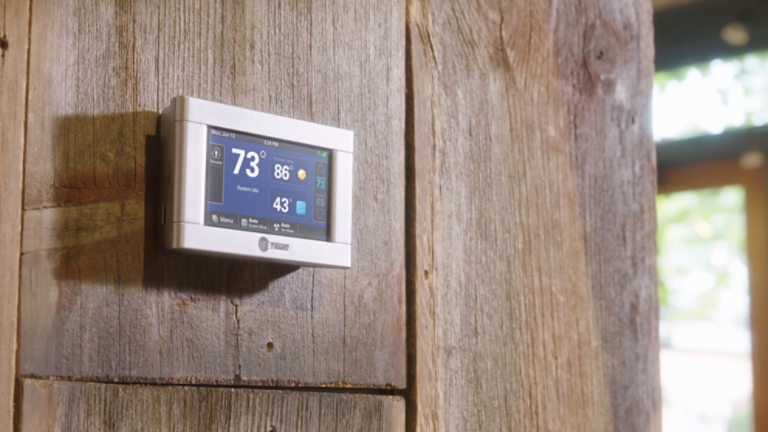
What Is a Programmable Thermostat?
A programmable thermostat is a temperature-control device that allows facility managers and building owners to pre-set specific heating and cooling schedules based on the time of day and the day of the week. Commercial programmable thermostats typically have an output for directly or indirectly controlling ventilation too.
Automating temperature adjustments and airflow ensures a commercial building is kept comfortable during business hours while conserving energy during off-hours.
How Programmable Thermostats Work
Unlike manual thermostats that require a person to physically adjust the temperature dial, a programmable thermostat operates on a user-defined schedule. Facility managers input temperature setpoints for different periods, which are typically categorized as occupied and unoccupied hours.
For example, a standard schedule might instruct the HVAC system to maintain a comfortable 72°F from 7:00 AM to 6:00 PM, and then automatically let the temperature drift to an energy-saving 65°F in winter or 78°F in summer overnight. Depending on the model, programmable thermostats offer different scheduling formats, such as:
- 7-Day Programming: Allows for a unique heating/cooling schedule for every single day of the week.
- 5-2 Day Programming: Uses one consistent schedule for weekdays (Monday–Friday) and a separate schedule for the weekend.
- 5-1-1 Day Programming: Uses one schedule for weekdays, one for Saturday, and one for Sunday.
The thermostat measures local air temperature and humidity and sends on/off or staged control signals to HVAC equipment, like furnaces, boilers, packaged units, chillers, heat pumps, and variable air volume boxes, based on the active schedule and the measured conditions. Some units accept inputs such as occupancy sensors or outdoor temperature.
Occupants or maintenance staff can temporarily override the active schedule and then return to the schedule, if needed. For example, when a meeting or special event takes place outside of normal business hours, a facility manager may need to manually override the predetermined temperature setting.
Benefits of Programmable Thermostats
Installing a programmable thermostat offers several benefits that more than offset its minimal costs:
- Energy savings: By automatically dialing back heating and cooling loads when the building is empty, facilities significantly reduce energy waste.
- Cost efficiency: Lowering the energy consumption directly translates into reduced monthly utility bills, improving the building's overall operating budget.
- Consistent comfort: The thermostat can be programmed to begin conditioning the space shortly before employees or customers arrive, ensuring the building is already comfortable right when the doors open.
- Reduced manual operation: It eliminates the risk of an employee forgetting to turn off or turn down the HVAC system at the end of the day.
- Extended equipment lifespan: By reducing unnecessary runtime during unoccupied hours, programmable thermostats limit wear and tear on commercial HVAC equipment, potentially extending its lifecycle.
Programmable Thermostats vs. Smart Thermostats
Programmable thermostats are more technically advanced than manual thermostats, but still have limitations compared to smart thermostats, like the Trane Pivot. While both devices automatically adjust temperatures, a programmable thermostat relies on schedules that are manually entered by a user, and it can operate without an internet connection.
A smart thermostat, by contrast, connects to Wi-Fi, allowing for remote monitoring and adjustments via mobile apps or a building automation system (BAS). Smart models may also use algorithms or occupancy sensors to learn a building's behavior and adjust schedules automatically.
To determine the best type of thermostat for your facility, contact your local Trane representative.