
Customer Story & Case Study
TG Kentucky Turns Waste Heat Into Competitive Advantage
TG Kentucky’s integrated heat recovery system captures manufacturing waste heat to advance both production goals and 2050 sustainability commitments.
Quick Facts
- Location
- Lebanon, Kentucky
- Industry
- Industrial & Manufacturing
- Products
- Building Automation Systems
- Topics
- Decarbonization • Energy Efficiency • Sustainability
Results
- 1st of-its-kind heat recovery solution
- Industry Award for innovative approach to industrial process cooling
- 20 additional units supported through scalable system design
- 1,100 team members at a facility now piloting a global sustainability model

Highlights
- Integrated heat recovery system projected to lower electricity use.
- Solution that directly advances Toyoda Gosei’s 2050 Environmental Challenge carbon neutrality targets.
- First-of-its kind global pilot within Toyoda Gosei’s network of 67 companies across 18 countries.
The Challenge: Expand Manufacturing While Lowering Carbon Emissions
For companies operating within Toyota's supply chain, carbon neutrality by 2050 is a business requirement When the TG (Toyoda Gosei) Kentucky facility in Lebanon, KY, a precision manufacturer of interior, exterior, and functional automotive components, began planning to expand manufacturing capacity, that directive was already a facility priority.
While a conventional path existed—copy the existing system design, expand production, and defer sustainability—it wasn't going to be enough. This path would deliver predictable results but leave the facility's greatest opportunity untapped.
Two major industrial processes—air compressors powering pneumatic equipment and plastic injection molding machines forming automotive components—were continuously generating and discarding heat. Historically, like most manufacturing facilities, these systems operated independently of the heating and cooling infrastructure. No one thought to connect them until Trane posed the question.
The Solution: A Heat Recovery System Built From the Inside Out
TG Kentucky initially set out to install a traditional cooling system, reaching out to Trane for new chiller options to support increased production. What followed was something different: looking at the facility as an integrated whole, as opposed to a collection of independent systems.
Trane saw that TG Kentucky's production challenge and its sustainability challenge were related. By solving both, Trane could set a model that the broader Toyoda Gosei network could follow—one with implications applicable to any industrial facility where precise temperature control is integral to the process.
That realization required more than engineering. For TG Kentucky, it meant abandoning decades of standard practice in exchange for the possibility of a solution that had never been implemented before. The decision required genuine trust: in Trane's technical expertise, in M&B Mechanical—TG Kentucky's preferred mechanical contracting partner—and in a fundamentally different way of thinking about what a cooling system could do. That trust was earned through close collaboration, transparent communication, and a shared willingness to explore options beyond a standard chiller replacement.
Turning Waste Heat Into Useful Energy
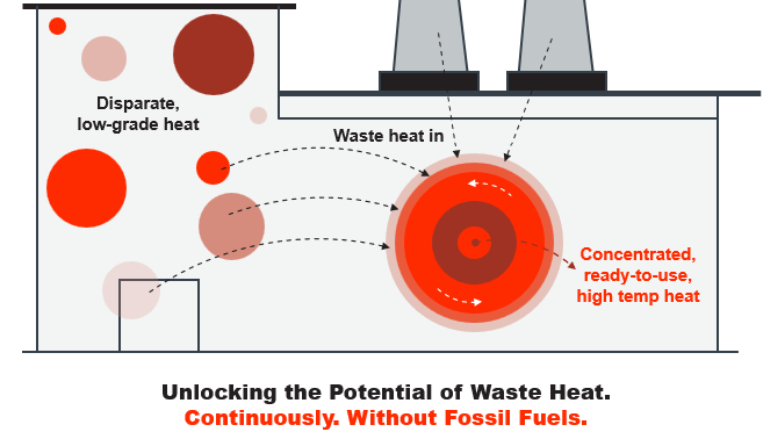
The new system introduced two heat recovery chillers connected through a variable distribution pumping loop. Water circulates through air compressors and injection molding equipment, collecting low-grade heat that would otherwise be discarded. The heat pump chiller then concentrates that energy, making it suitable for direct reuse in the manufacturing process.
“When we looked at the entire manufacturing process, it became clear the waste heat could be captured and leveraged as a production resource—advancing both goals at once,” said Eric DeLodder, Sales Engineer at Trane.
That recovered heat now preheats make-up air for the plant's paint booth systems, significantly reducing natural gas consumption and scope 1 emissions. A water-side economizer also allows the facility to shift to free cooling when temperatures drop below 45°F, reducing mechanical chiller runtime and scope 2 emissions. A Building Automation System (BAS) coordinates pumps, valves, and sequencing in real time while monitoring temperature and pressure points across the system.
Designed for a Complex Manufacturing Environment
At TG Kentucky, heating and cooling aren't just about occupant comfort. They're part of how the product gets made, where precise temperature control directly affects production quality and consistency. The chilled water system had to integrate directly with live manufacturing operations, requiring close coordination and a willingness to rethink long-standing practices.
The design also incorporates modular scalability: provisions for additional components allow new equipment to be added without redesigning the cooling infrastructure, supporting future expansion.
The Results: Reduced Energy Usage and Increased Efficiency
Projected outcomes include meaningful reductions in electricity consumption, natural gas use, and greenhouse gas emissions, directly advancing Toyoda Gosei's 2050 carbon neutrality targets. Early indicators are positive.
“The transition to free cooling and heat recovery has truly elevated our operational efficiency,” said Gregory Caldwell, TG Kentucky Site Operations Leader. “We now enjoy dependable process cooling and substantial energy savings with full control and flexibility.”
The project has already earned industry recognition, including an Energy and Environment Award for its innovative approach to industrial process cooling and waste heat recovery.
But the larger significance extends well beyond Lebanon, KY. As a global pilot within Toyoda Gosei's network of 67 companies across 18 countries, the TG Kentucky installation is now a proof point that other facilities in the network can follow. For TG Kentucky, the willingness to rethink a simple equipment request unlocked a solution that advanced production, sustainability, and operational reliability simultaneously. For Toyoda Gosei's broader network—and for any industrial facility where temperature control is core to the operation—it demonstrates what becomes possible when you take a holistic approach to how systems work together.