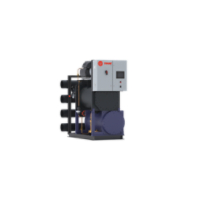
What Is a Centrifugal Chiller?
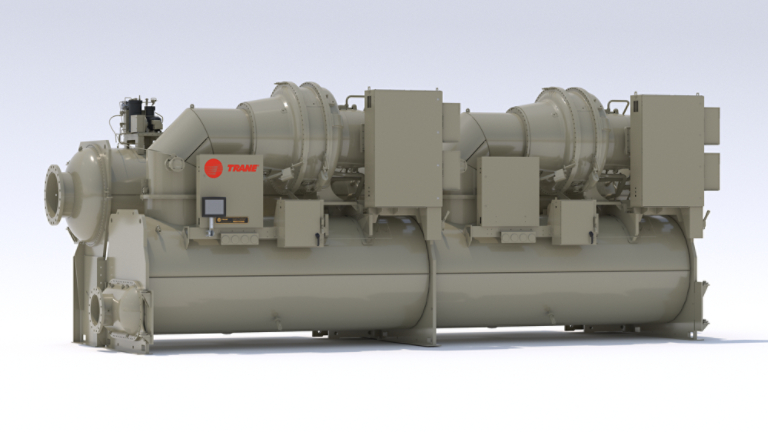
A centrifugal chiller is a large, high‑capacity refrigeration system used for air‑conditioning and process‑cooling applications by employing a motor‑driven centrifugal compressor. Centrifugal chillers are commonly used in commercial, institutional, and industrial facilities where cooling loads are large and continuous.
How Does a Centrifugal Chiller Work?
A centrifugal chiller uses motor-driven impellers that increase the pressure and temperature of the refrigerant using centrifugal force. Capacity control is typically modulated via inlet guide vanes that actuate to control refrigerant flow. The four main components are:
- Evaporator: Here, the cold, low-pressure liquid refrigerant flows around a bundle of tubes containing water from the building. The refrigerant cools the water by absorbing heat from it, causing the refrigerant to boil and turn into a gas. The now-chilled water is then circulated throughout the building to provide cooling.
- Compressor: The key component that gives the centrifugal chiller its name is a rapidly spinning impeller. Similar to a fan, it draws in the low-pressure refrigerant gas and uses centrifugal force to compress it, significantly increasing its pressure and temperature. This high-pressure, hot gas then moves to the condenser.
- Condenser: In the condenser, the high-temperature refrigerant gas flows over another set of tubes that contain water from a condenser loop (for example, a cooling tower or dry cooler). The heat from the refrigerant is transferred to the cooling tower water, causing the refrigerant to cool down and condense back into a high-pressure liquid. The cooling tower water then carries this absorbed heat out of the building and releases it into the atmosphere.
- Expansion device: The high-pressure liquid refrigerant then passes through an expansion device, which reduces its pressure and temperature, returning it to its original low-temperature, low-pressure state. From here, it re-enters the evaporator to begin the cycle anew.
Some of Trane's centrifugal chiller models offer heat recovery that allows the absorbed heat to be recovered and used elsewhere in the system instead of rejecting it outside the building. This option further improves the energy efficiency of the system.
Types of Centrifugal Compressor
The core component of a centrifugal chiller, centrifugal compressors utilize spinning impellers to compress refrigerant gas and facilitate large-scale cooling. They generally fall into two categories based on the bearing technology they employ: oil-lubricated systems or oil-free magnetic bearing systems.
- Oil‑lubricated centrifugal compressor: A centrifugal compressor that uses an oil lubrication system for bearings and shaft sealing. Oil provides hydrodynamic lubrication for journal/tilting‑pad bearings and is circulated through separators, coolers, filters and pumps to protect rotating components and remove heat. Common in commercial chillers for their proven reliability and lower up‑front cost.
- Oil‑free (magnetic bearing) centrifugal compressor: A centrifugal compressor that supports and centers the rotor using active magnetic bearings (AMB) rather than oil film bearings. AMBs levitate the shaft with electromagnetic forces controlled by high-speed sensors and electronics, eliminating the machine oil system and associated oil-handling components. Magnetic bearings allow for higher speeds and better part load efficiencies.
Benefits of Choosing a Centrifugal Chiller
Centrifugal chillers offer several key advantages that make them attractive for building owners and facility managers:
- High capacity: They work well for large buildings or campus systems. These chillers are typically used for large office buildings, hospitals, data centers, universities, or industrial plants.
- High efficiency at scale: Centrifugal chillers often deliver lower energy use (better kW/ton) than many other chiller types when operating near design loads.
- Lower operating costs for large loads: Over time, the energy savings can offset higher initial costs in large installations.
- Footprint flexibility: For large chiller plants, centrifugal chillers can be configured to optimize space utilization. For retrofit applications, some chillers can be disassembled for tight installations.
- Fewer moving parts in the centrifugal chiller compressor: Fewer parts can mean smoother operation, reduced vibration, and long life when maintained properly.
- Excellent for variable load systems: Modern centrifugal chillers can maintain efficiency over a wide range of operating conditions.
Centrifugal chillers can integrate with building automation systems for optimized control, peak‑demand management, and monitoring.